
For the better part of a year I lived among them. I set up my blind behind a ficus in a split-level ranch house, ate what they ate (mostly pretzels, mostly standing up), and logged every vocalization in a waterproof notebook. My goal was simple: to observe the Partisan Voter through one complete election season without being noticed, shared, or blocked.
The species is not rare. It is found on every continent with Wi-Fi and in great density wherever a television is mounted above a fireplace. Field guides traditionally divide it into two subspecies, the Red-Capped and the Blue-Capped, which for decades were believed to be mortal enemies with nothing in common. Genetic sampling at our field lab told a different story. The two are 99.9 percent identical. The remaining 0.1 percent is which channel they leave on during dinner.
A grazer of headlines
The Partisan Voter feeds almost exclusively on headlines. It does not consume articles, which it regards as the inedible husk around the headline. Using a stopwatch and a great deal of patience, my team clocked the average time between a headline appearing on a screen and the specimen forming a lifelong opinion about it at 0.8 seconds. Opinions about the article itself took zero seconds, because the article was never opened.
“People assume it eats the story,” said Dr. Wendell Pomp, a behavioral ecologist at the Institute for Advanced Shrugging, which I should note does not exist. “It doesn’t. It sniffs the headline, decides whether it already agrees, and then regurgitates it to the rest of the herd. We call it the share reflex. In some groups it fires before the eyes have finished moving.”
“It sniffs the headline, decides whether it already agrees, and regurgitates it to the herd.”
Marking territory
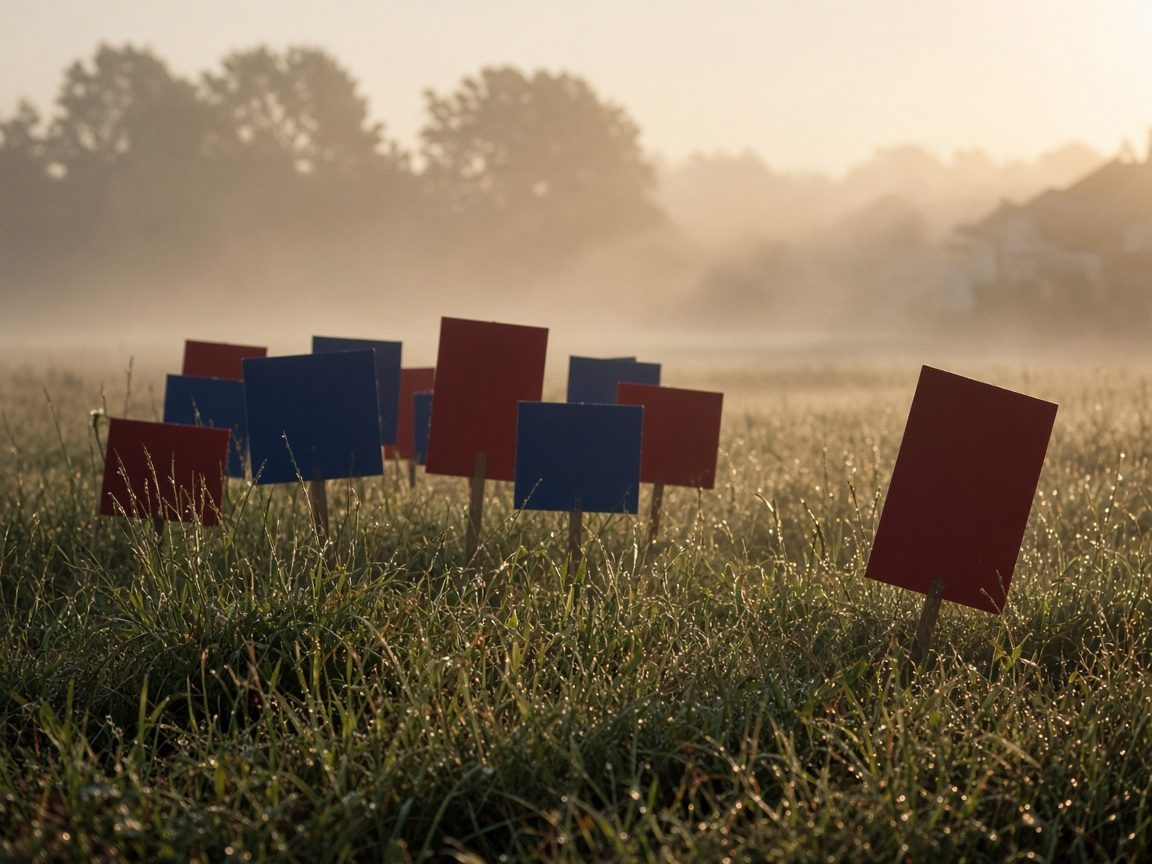
In autumn both sexes mark territory with lawn signs, planted at the edge of the range and angled toward the street for maximum visibility to rivals. A sign is never placed to persuade. Its purpose, as far as we can tell, is to let the neighbors know which neighbors not to wave at. During peak season I counted one sign for every 1.4 residents on a single cul-de-sac, including a house that was for sale and therefore had two.
The call of the wild
The Partisan Voter is highly vocal. Its best-known call, a sharp “Do your own research!”, is used to end conversations rather than begin research. Its alarm call, “Wake up, people,” is most often issued from a seated position at 11:40 p.m. Both subspecies use both calls. When I played a recording of a Red-Capped call to a Blue-Capped male, he agreed with it completely until I told him where it came from, at which point he became visibly distressed and had to lie down.
The annual migration is the most dramatic event in the species’ calendar. Each November, millions of individuals travel hundreds of miles to sit at a single table with relatives of the opposite cap color. Biologists have long wondered why they make the journey. The leading theory is pie.
An experiment goes wrong
Late in the season we attempted a feeding trial. In the specimen’s regular path between the couch and the refrigerator, we placed a calm, well-sourced, three-thousand-word explainer with footnotes and a chart. He walked around it as if it were a puddle. We then replaced it with a single headline in capital letters that ended in a question mark. He charged it from across the room, shared it with forty-one contacts, and announced that he had always known.
“That’s textbook,” Dr. Pomp told me later. “Nuance has no scent. Certainty smells like bacon.”
A glimmer of something
On my last night in the field, something remarkable happened. The adult male put down the remote, turned to his teenage daughter, and asked her what she thought. She told him. He listened for almost four full seconds, the longest uninterrupted listening our team recorded all year. I held my breath. My photographer held his breath. The ficus, I believe, held its breath.
Then his phone buzzed.
Conservationists call moments like that hope. Everyone else calls it the commercial break. I packed up my blind the next morning with a heavy heart and a full notebook, and I can report, with some joy and much regret, that the species is thriving.
Satire This article is a work of comedy. Dr. Fieldnote, Hollis Longlens, Dr. Pomp, and the Institute for Advanced Shrugging are fictional. Photos are AI-generated illustrations of no real person. National Sarcastic is not affiliated with National Geographic.